Let's Talk About Children
How are you? How are the children?

Since the November election, I’ve been part of so many conversations about questions of, “How do I . . . [insert: parent, work with children, model activism, take care of myself] in response to events and news stories?” After inauguration day and when the avalanche of executive orders out of the White House began, my mind turned to our children. How would they hear, experience, and perceive both the tone of what is happening in our country, and its actual outcomes?
As I wrote about before the 2024 election, children and youth may be aware of the responses of the adults around them and experience their own questions and concerns about the news and events happening now. As the weeks progress, my concern rises along with the seriousness of what we’re witnessing. In addition to responding to what children directly ask us and share, we have an opportunity during this time to remind and reassure them about who we are as Friends and what we can continue to do. This is a form of accompaniment.
Accompaniment on a journey can make an extraordinary difference, whether the journey is physical or spiritual. The times we’re living in may feel like a disorienting new path, or like a familiar road walked too often. Beyond politics, children (and people of all ages) are living with deep concerns, worries for the future, and uncertainty about what all this means for them, their neighbors, friends, and family. How can we provide accompaniment and spiritual nurture to children and young people in this time? What messages can we share with our children that tell them that we are listening and walking beside them?
You belong. (Everyone belongs.)
Because the message I heard most clearly from the new administration in its first days was: Not everyone belongs. Then I remembered that belonging is the place to begin. This is the first message for our children: You belong. With all your identities, questions, and with both your hopes and worries. An educator shared with me that a student who identifies as non-binary asked their teacher after the inauguration: “Can I still be they/them?” Can I still be who I am? Yes, you belong. And we are here to accompany you, in community.
This administration may tell us that you do not belong here in the US if you are an asylum seeker, if you have undocumented parents, if your gender does not fall into one of two binary categories, if you are a transgender youth, if you are a woman in military leadership, if . . . People are of course wondering who else this “if” may include for the current president and his followers in coming days.
Let’s share with children and youth the actions being taken by Quaker communities and organizations in response to the “othering” being done. This is a time to introduce even younger children to the work and witness of the Friends Committee on National Legislation and the American Friends Service Committee.
Tell children and youth that Friends and other people are not staying silent, and that adults around them are responding with love for our neighbor.
Your story is part of a shared story.
One of the ways we can demonstrate that everyone belongs is through sharing and listening to stories. The idea that children need “windows and mirrors” in the stories they experience is not new in education, and in Quaker religious education we seek to provide both views in the choices we make about books to read and stories to tell.
When we create spaces for young people to tell their stories and hear the stories of others, it helps them develop empathy, which has been found to be one of the biggest predictors of openness to diversity. In our adult lives, what might be the result of listening more to the stories of people different from us (including political and ideological leanings)? What if we spent more time learning to tell our own stories, to share and celebrate who we are? How might compassion for each other’s well-being grow, even when we disagree?
The message that your story and “their” story are both parts of the whole story – let’s say that to our children.
We seek the Beloved Community together.
Whether the language you prefer is Kingdom of God or Beloved Community, we need to tell our children that this is still possible here on Earth and in our lives. This happens in gestures and actions of all kinds, from small kindnesses to participating in protests. South African bishop Desmond Tutu reminded us: “Do your little bit of good where you are; it's those little bits of good put together that overwhelm the world.” The picture book Good People Everywhere by Lynea Gillen (here’s a link to a free PDF!) shares the message that everywhere people are doing good things – and so will you.
In late January, I made a visit to the Friends school where I share Faith & Play stories with classes every month. I had planned to share a story about Dr. Martin Luther King that month, but reflecting on events around us decided to share another story that connects with Dr. King and his work. “Jesus Teaches the People”1 is about the message in the Beatitudes; for a diverse school community I began with the acknowledgement that there are many teachers around us, including those from long ago whose lives and words we remember today (Moses, Buddha, Muhammad, Jesus). From the story:
And the teacher named Jesus didn’t just talk about the beloved community; he showed people, again and again, what it can be like. His teaching encourages us that our faith should become practice, grounded in love.
You don’t have to have all the answers. You don’t always have to be right. You don’t have to be the best. Love other people. This is always enough.
Be gentle. Show kindness even to those who do not show it to you. Know what it means to be generous and humble. There is great strength in these things. Goodness will grow.
You are loved and forgiven, even when you forget to act in love. Forgive other people. Do what makes peace.
Some day the beloved community will be full and complete on earth. Pray for this. Work for it together.
All of you are light for the world. Let your light shine. Let your life speak.
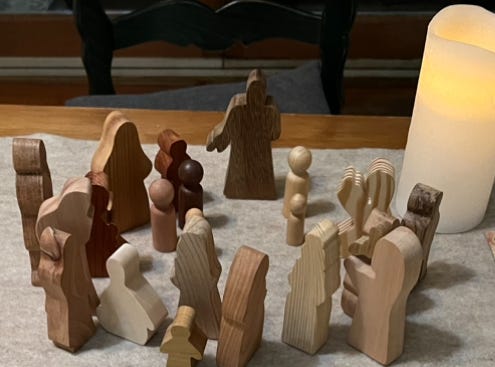
We can encourage our children that mercy, compassion, and love are still what we work for now. When I told this story, children from PreK to 5th grade were exceptionally still in our circle on the floor and their wondering about it was reflective. One young student gestured to the materials, and said, “I see all the testimonies in the story!”2 Grounded in our Quaker testimonies, in gestures and actions of all kinds, we continue to seek and build the beloved community.
Resilience in Community
Friends of all ages are on this journey together. For adults who work with and live with children and young people, there is wisdom in the advice to take care of yourself, pay attention to where young people are (do not assume or project feelings about events), provide accurate information, move to action you can take, and make space for prayer and silence as well as support from those around you.
In the 2017 book My Grandmother’s Hands3, Dr. Resmaa Menakem describes resilience as being not a thing or an attribute but a "flow" moving not just through an individual but between multiple bodies when they are harmonized in a larger relationship – with a family, a group, a community, or the world at large. This kind of thinking makes me feel hopeful that faith communities can (and do) serve as places of collective "flow" and shared practices that nurture resilience. But we need to be intentional about creating shared spaces for worship, witness, grief and joy, to sustain us and our children together.
You belong. Your story is part of the bigger story. With our words and actions we continue to seek the beloved community. In our families, in our schools, in meetinghouses and churches, and in relationship with our neighbors, we can remind one another of these messages, and that God is never far away, but as close as breath. We continue on the path Micah 6:8 puts before us: Do justly, love mercy, walk humbly. The time is always now.
Resources to Share:
Messages of Solidarity:
Love Thy Neighbor: A minute in support of the dignity and basic human rights of transgender and gender non-conforming people (New York Yearly Meeting)
Friends General Conference Joins over Two Dozen Religious Groups in New Immigration Lawsuit
The pope rebukes Trump over migrant deportations and refutes VP Vance's theology
From Teen Vogue: “Dear Trans Kids, You Don't Need the Government's Permission to Exist”
From Illustrated Ministry guest writer Nii Addo Abrahams: a free downloadable youth group Bible study. "Young people are passionate about justice but might not see church as the place to discuss it. But antiracism is actually a deeply faithful way of life. We’re here with some theological and practical insights on facilitating those conversations and building an antiracist youth group."
From Illustrated Ministry guest writer Deborah Jodrey: “Bishop Budde’s Plea for Mercy and a Call to Action” – a free lesson based on Bishop Budde’s sermon and plea for mercy. Download the lesson and coloring page to share with youth and discuss how to speak truth to power.
From Holy Troublemakers & Unconventional Saints: There has never been a better time for this collection of stories and two companion curricula that celebrate a diversity of faithful lives that center belonging, hope, and witness!
From Embrace Race: “‘Color-Blind’ or Color-Brave? Two Views on Race & Kids”
To know me, is to know I love a booklist! This one is pretty amazing, and has categories to explore: Books for Post-Election
With thanks to my friend Michael Gibson, whose work this is adapted from.
OK, yes, they actually said, “all the SPICES” and I replied with a smile, “Yes, all the testimonies.”
Menakem, Resmaa. 2017. My Grandmother’s Hands. Las Vegas, NV: Central Recovery Press.